
– The Performance Ecosystem –
The Ambition
“The difficulty lies not in the new ideas, but in escaping the old ones.”
— John Maynard Keynes
The business model that got you here is under pressure in ways that didn’t exist two years ago.
AI agents are threatening the pricing assumptions the company was built on. Customers are consolidating vendors. The growth playbook that produced real results two years ago is producing smaller returns on the same inputs today.
Hold on to your old model, and the gap between plan and results widens faster in these current market conditions.
I’ve been in meetings where the old model genuinely cost companies. A category-changing piece of innovation got introduced cautiously, drip-fed out over months instead of launched with the investment it deserved. I’ve watched proposals get safer with every round of review until the version submitted barely resembled the one that could have mattered to the customer. And I’ve seen products engineered well past what customers needed, simply because the team did not trust that the market would accept what was already very good.
In every case, the team had a good plan, good people and were more than capable. Unfortunately, the model didn’t support either.
The leadership instinct behind all of these cautionary tales is the same: manage the disruption, wait for things to settle, protect what’s been built. Instincts and an old model not adapting well are the contributing factors to CEO confidence in revenue growth falling to a five-year low this year, sharply down from three years ago.
Most leaders feel the old model losing grip. It doesn’t support them or the decisions that need to be made now. The problem is few have found a different one.
Instead what happens is we revise our goals, qualify the results, reset ambitions and make different decisions to fit the model. The tension you feel is what hasn’t changed: your nature to deliver products that have impact, do meaningful work and build sustainable growth.
What if instead of dampening your ambitions you changed how you go about acting on them?

The Ceiling
Here’s where that starts.
The gap between plan and actual doesn’t suddenly announce itself. It shows up first as friction: a decision that takes a week when it should take a day, a customer concern raised more than once before anyone acts on it, a signal from the market that never reaches the person who could do something with it. Each of those is a piece of performance the company already has and isn’t using. At this point in the year, that loss is becoming impossible to miss.
This is the ceiling: the point where effort stops turning into results, no matter how hard the team pushes against it.
It sounds contradictory, but most companies hit this ceiling with all the right pieces already in place. That’s not a performance problem. It’s a utilization problem: the capability already in the team, and the insight already coming from the market, aren’t fully reaching the work.
Utilization is a symptom, not the cause of the ceiling itself. Capability and insight only convert into performance when the conditions let them, and right now, the conditions aren’t built for it.
It doesn’t matter how good the team is or how much the market is showing you. If the conditions aren’t there to convert that capability and that insight into decisions, none of it becomes performance because better performance emerges from alignment, not effort alone.
Here are three examples of the ceiling at work.
Revenue grows slower than it should because each function head carries their own piece of the business alone: product carrying the roadmap, sales carrying the customer relationships, nobody seeing the whole picture except the person at the top. The missing condition is a shared, current view the whole leadership team operates from. Without it, the CEO carries all of it, and the gap between what each leader sees and what the company needs grows a little more every quarter.
A customer concern gets raised more than once before anyone acts on it, not because no one heard it, but because what was heard stayed where it landed: in the call notes, with whoever first noticed it. The missing condition is ownership: nobody is assigned to move a signal once it’s been noticed, so someone has to personally chase it forward every time. That chasing is the coordination cost, the hidden tax of a gap like this, adding overhead that slows execution without showing up on your dashboard.
And now AI speeds up the one part that was never the problem. Information moves faster, coordination improves, but the conditions that determine who’s trusted to interpret that information and act on it were never rebuilt for the new speed. Faster information into weak conditions doesn’t produce better decisions. It produces faster chaos.
This is the damper on sustainable growth. Not a shortage of talent, and not a shortage of signal. Conditions that were never built to decide what happens once capability and insight show up.
That’s the real distance between plan and actual: not what the company knows, but what its conditions let it do with what it knows.
Close that gap, and the plan you already have starts producing what it was always capable of.

The Turn
What you’re feeling isn’t a leadership problem. It isn’t a talent problem. It’s a conversion issue. There is a gap between what your customers need and what your company is delivering, and that gap is a conditions problem. Your current model was never built to govern those conditions. In fact, it’s likely holding you and the company back.
There’s a different way to look at your business. Not as a machine to optimize: add better parts, remove friction, increase efficiency. That lens has a ceiling, because it treats what’s wrong as structural when it’s a different kind of problem entirely. Picture the company instead as an ecosystem: three interdependent zones, Talent, Culture, and Customers, converting the capability and capacity your company has into what your customers need now and next.

Talent’s role is to supply the usable capacity of the company to turn signals into insight, insight into decisions, and decisions into coordinated action that creates value. Capability is what your people can do. Capacity is how much of that capability can be used, and it’s not fixed. When conditions are right, capacity appreciates: judgment sharpens, trust compounds, and the same team produces more capacity the longer conditions support them.
Culture’s role is to convert that capacity into results. Culture isn’t what the company says about itself. It’s how the company actually operates, especially when pressure hits: how work happens, what gets prioritized when priorities shift, how decisions get made and whether they hold, and whether people feel safe enough to act on what they know.
It’s the only zone working in both directions at once, shaping capacity from the inside and relevance from the outside at the same time. Culture determines not just what is created, it determines what is allowed: which decisions get made without asking permission, which ideas get a real hearing, which signals get acted on instead of filed away.
Customers’ role is to supply the demand: the evolving system of needs, behaviors, and expectations that generate it, and that actively shape how what you offer gets accepted and used. Demand isn’t created. It’s revealed, interpreted, and responded to. Customers show you where they’re heading long before they act on it, before a competitor even notices the opening. That’s why signals precede revenue.
Put those three zones together, and you have the Performance Ecosystem. Every company already has one, running whether or not anyone is operating it deliberately. There is nothing to install. No extra work. Just the work you set out to do, finally happening the way you meant it to. Leaders just need to start operating it consciously instead of leaving it to run on its own.
That distinction matters because of how the three zones actually behave together. Like water, air, and light in any natural ecosystem, they don’t just work better in combination. They’re required in combination. Take one away, and growth doesn’t slow down. It stops.
That interdependence is the reason why performance is determined by the quality of conversion of capacity into value under changing conditions.
Once you see performance this way, you see where competitive advantage actually comes from too. Not from structure or process, but from the quality of the conditions a leader governs. Leaders who govern the conditions of their company deliberately don’t just create better alignment. They build companies that distribute intelligence instead of concentrating it in whoever’s carrying the most at the top, and that makes them more innovative, more responsive to customers, and harder to replicate than companies built on structure alone.
In other words: leaders govern conditions. Conditions govern conversion. Conversion governs growth.
You’ll feel this before you ever see it in a number.
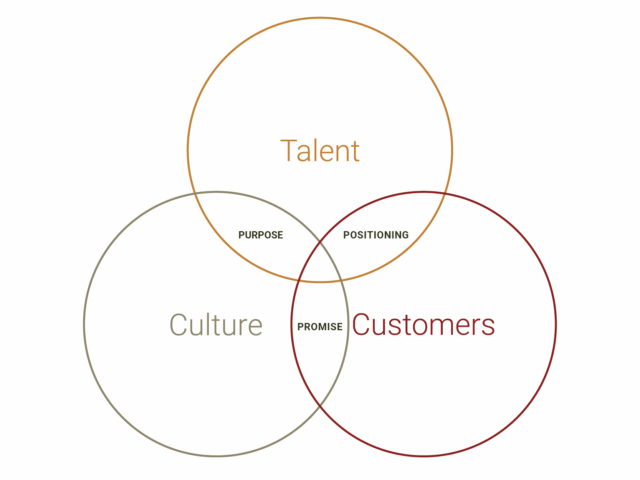
Where Talent meets Culture, you get purpose: not a value on a wall, but the conditions that let your best people do work that matters and stay for it. Where Culture meets Customers, you get promise: not the line in a brand brief, but what customers come to believe is true about you, based on what your culture actually produces when no one’s watching. Where Talent meets Customers directly, you get positioning: whether the market already sees you as the company worth choosing before any sales conversation starts, and whether the best people want to build for you because of it.
Purpose keeps your best people converting instead of leaving, months before a resignation letter would ever tell you. Promise keeps your best customers renewing instead of comparing you to someone else, long before a churn report would catch it. Positioning gets you chosen before you ever have to pitch.
This is where the gap between plan and actual closes. Not in the plan. In the conditions around it.
That’s not abstract. Govern those conditions well, and the business changes in ways you can point to. Talent capacity improves. The work becomes more meaningful, and retention follows it. Conversion improves. Customer churn lowers, the value of every relationship grows, and the product itself gets better, because it’s built on strong customer reads and fully utilized company capability. That is extremely difficult to compete with.

The Shift
The shift is simple to describe and hard to feel: the company stops running through you, and starts running through its own conditions instead.
Right now, you’re the one holding what your current model can’t: the decision that stalls three layers down still lands on your desk, the watered-down proposal still needs your judgment later under worse conditions, the overbuilt product still needs you to explain why it shipped late. None of that goes away because you work harder. It only goes away when the conditions change.
When the shift happens, talent shows up as distributed intelligence: the thinking scattered across sales, product, operations, and every customer conversation finally combines into something no single part of the company could produce alone, and none of it has to route through you first.
Culture shows up as ideas that were staying in meetings finally reaching decisions, and curiosity that was waning starts building again. Judgment improves. Decisions that used to get delayed move forward faster.
Customers stop being receptacles you deliver to and become receptors instead: not endpoints you dump the product on, but participants who receive it, judge whether it has value, and show you where it needs to go next. A renewal that comes in on time, with a good conversation attached, used to read as stability. Now you can tell whether the customer actually found value in it, or just let it renew.
Products with impact. Work that means something. Growth that sustains in all conditions. None of that was ever the wrong ambition. It just needed conditions capable of doing it. This is the version of the company where growth doesn’t drain the people producing it, where the culture holds instead of stretching thin under the pace, where you’re no longer the one absorbing whatever the system fails to catch. It’s not a different company. It’s the one you were always trying to build.
When the system works, you don’t just get more growth. You get Better Growth.
Better Growth is the difference between growth that costs you and growth that compounds. Growth that costs you burns out the people producing it, gets brittle under pressure, and hollows out why the work mattered in the first place. Better Growth does the opposite. More capacity without more headcount. Better retention without new incentives. A stronger product without a bigger roadmap. Each zone converting well makes the other zones convert better.
This isn’t growth in spite of your people, your culture, or your product. It’s growth because of them.
That’s the shift, not a new plan, but the current one, finally converting better, because talent is fully utilized, culture is converting for revenue and innovation instead of just morale, and customers are more receptive to a product that’s finally more relevant. The capability was already there. The conditions just needed to be governed deliberately rather than left to form on their own.

The Choice
The business model under pressure isn’t the problem. The conditions running it are, and that pressure isn’t waiting for you to catch up.
Govern the conditions, and the same job you’ve always had finally does what it was always supposed to do: leaders govern conditions, conditions govern conversion, conversion governs growth.
You’ve seen the ceiling. You’ve felt the turn. This is the shift: growth you can hold onto, work that means something again, a company harder for anyone else to copy, built the way you always intended.
Follow your nature, not your instinct.
Instinct protects what already exists. Nature builds what doesn’t exist yet, and it’s the only one of the two that was ever going to get you to the company and the products you set out to build.
The question was, what would happen if you changed how you acted on your ambitions instead of dampening them. Now you know.
John Maynard Keynes said the difficulty lies not in the new ideas, but in escaping the old ones. You’ve just seen the new one. You know the way out now.
Series note
This is the fourth and final piece in a quarterly series on the Performance Ecosystem.
April: Talent, the capacity zone, and where convertibility begins.
May: Culture, the conversion environment that determines whether capacity becomes value.
June: Customers, the demand that gives conversion its direction and meaning.
July: The full system together, and Better Growth as what happens when it works.
For leaders who are seeing this pattern, this is exactly the work we do together.
Framework note
Most growth companies become more capable than they become effective. The Performance Ecosystem is an original framework developed by David Edward of Strategic Initiatives Group to close that gap: converting the company’s capability into the results it should already be producing. It identifies three interdependent zones: Talent, the capacity zone; Culture, the conversion mechanism; and Customers, the demand zone. Together they are governed by a single cascade: Leaders govern the conditions. Conditions govern conversion. Conversion governs growth. When the system works, the gap between what the company is capable of and what it is producing begins to close. That is Better Growth. Learn more at sigunlimited.com.