
The customer is still there. The urgency isn’t.
The conversations are still happening. Customers still have needs. The market is there. But something has changed around the business. Buyers ask more questions, take longer to decide, and commit with less conviction. The value story that used to land deals now seems to land with less force.
Most leadership teams read this as a sales problem, a messaging problem, a positioning problem, or a product problem. Any one of these may be true but, in my experience, something else is happening. Customers have been showing and telling the company something for a while.
Customers move further away before they move on.
Forrester’s 2024 State of Business Buying report found that 86% of B2B purchases stall and 81% of buyers express dissatisfaction with their chosen providers. The gap is widening between what companies believe they are offering and what customers experience as valuable.
Customers have not stopped telling you what matters. Most companies have plenty of customer data. What is harder is recognizing what customers are showing through hesitation, longer deliberation, less urgency, and behaviour that no longer fits the plan. This is where the Customer zone of the Performance Ecosystem begins.

What Customers Actually Are
Most companies know their customers through categories: segments, personas, accounts, buyers, users, pipeline, renewal risk. These categories help organize the market, assign responsibility, and target communication. They are important and useful, but they are not the whole customer.
A customer who delays is showing you something. A buyer who compares is showing you something. A renewal conversation that feels different from last year is showing you something. We tend to manage these as buying process problems and miss the chance to understand where customers are going before they move on.
Customers are doing two things at once. They are receiving what the company creates and deciding whether it has value. At the same time, they are showing what they need next through behaviours and actions that often do not fit the company’s customer profile.
This is a different kind of customer than the one most companies manage. Customers are more than endpoints in a delivery process. They are receptors of what the company builds and signalers of where the product, service, or relationship needs to go next. The company that wins share of hearts, minds and market understands both.
Customers are receptors, not receptacles.
That view changes what leaders measure. If customers are receptacles, leaders measure delivery: what shipped, what sold, what moved through the pipeline. If customers are receptors, leaders measure reception too: whether customers still find the product valuable, whether they are leaning in or moving away, and whether the relationship is strengthening or simply continuing.
When leaders see customers this way, customer intelligence becomes the company’s way of understanding whether what it builds next will be received as valuable, or whether the distance between what the company creates and what customers need is widening.
In my experience, this is where companies lose ground.

Customer Input Is Not Customer Intelligence
Most companies are not short on customer “tells”: sales notes, usage data, renewal conversations, win-loss analysis, onboarding friction, customer success patterns. The problem is rarely that no one has heard anything. Often, the problem is interpretation.
A buyer’s hesitation gets noted but not interpreted. Sales hears the same concern on three consecutive calls, and it stays in the call notes. A product ships and adoption is softer than expected. Customer success flags the same issue for the third month running, and it remains in the report.
Those are conditions problems, not customer problems. Each signal stayed where it first appeared. No single signal seemed strong enough to change anything. But together, they were the raw material for intelligence about where customers are heading and what the product or service must become to meet them there.
Converting raw data into intelligence requires conditions that allow what is heard in one part of the company to be shared, interpreted, and used somewhere else. The gap is not in the data. It is in the conditions the company has created to turn that data into shared understanding.
Customer input tells you what customers are saying. Customer intelligence helps you understand where they are going.
When input does not become shared intelligence, the cost shows up later: product decisions that miss the real need, launches that miss plan projections, and sales cycles that lengthen.

The Difference Between Delivery and Reception
Most conversations about customers conflate two distinct things. Understanding both changes where the leader looks and what is measured.
Delivery is what the company puts into the market: the product that ships, the service that launches, the promise that is made. Reception is what happens on the customer’s side: whether the product fits the need, whether the service earns trust, whether the need to act is present and urgent.
In most growing companies, delivery is measured. Reception is assumed.
It can be a dangerous assumption. Consider this: A customer renews on time. The conversation was positive. But there was no growth. Leadership reads the renewal as stable. The customer signals it as sufficient. Bottom line: The company saw continuity. The customer showed a transaction.
Delivery thinking sees revenue. Reception thinking sees future revenue opportunity.
A transaction extracts cash. A relationship reveals where value may move next. Another way to look at it: value is not delivered. It is accepted, adapted, or ignored by the customer. Innovation is not what the company creates. It becomes innovation only when customers accept and use it.
Leaders are responsible for whether the company understands how customers are receiving, trusting, delaying, or rejecting what has been built. It takes an active capability to read what customers are showing and enough trust to let that understanding reshape the next product or service.
The leaders of these companies read their customers the way a great barista reads a regular, remembering not just what was ordered last time but what was almost ordered, what was lingered over, what was asked about. Over time the product stops feeling like a transaction and starts feeling made for them. That is a company paying attention long enough, and caring deeply enough, to know its customer.
The limit on growth is not only what the company creates. It is the depth of relationship that determines whether what it creates keeps being received as relevant, valuable, and worth acting on.
Clayton Christensen gave leaders a framework for answering exactly that question.

The Most Important Job To Be Done
Clayton Christensen gave leaders one of the most useful reframes of customer behaviour. His Jobs to Be Done approach argued that customers do not simply buy products. They pull solutions into their lives to make progress in specific circumstances. The question for the company is: what are they trying to accomplish?
I agree with Christensen that customers are not segments or profiles. They are trying to make something better, easier, faster, or less painful in their lives or businesses. Understanding what they are trying to accomplish is a more complete understanding of the customer.
But Jobs to Be Done reaches its limit if company conditions are not right. A company can know exactly what customers are trying to get done and still build the wrong thing, because the input never became intelligence and never reached the people who needed it.
That distance is where most companies lose the value Christensen’s framework offers.
Customer understanding becomes valuable only when it reaches the decisions that shape what the company creates, stops, serves, and promises.
The Performance Ecosystem is built to deliver just that.

Capacity, Conversion, Demand
After more than thirty years working with leadership teams across industries and stages of growth, what I found is that the companies that remained relevant were not always the ones with the most talent or the sharpest strategy. They were the ones whose talent, culture, and customers were working together. What emerged from that work is a system I call the Performance Ecosystem.
The Performance Ecosystem is a dynamic system that determines how effectively a company converts its internal capacity into value in response to changing demand. Every company already has one. There is nothing to install. Leaders just need to operate it consciously rather than letting it run on its own.
Talent gives the company capacity.
Culture determines whether that capacity converts.
Customers determine whether what gets created still matters.
The Performance Ecosystem is symmetrical and interdependent. Talent is the capacity source, Customers are the demand source, and Culture is the connecting mechanism. Performance emerges from how effectively capacity and demand are converted into value.
When the system is not working, execution feels heavier, growth feels harder and customers feel more distant. Talent without Customers is capacity aimed at the wrong outcomes. Customers without Talent is demand that cannot be answered. Culture without both has nothing to convert and no direction to convert toward.
When the three forces work together, the gap between what the company is capable of and what it is producing begins to close. That is Better Growth.
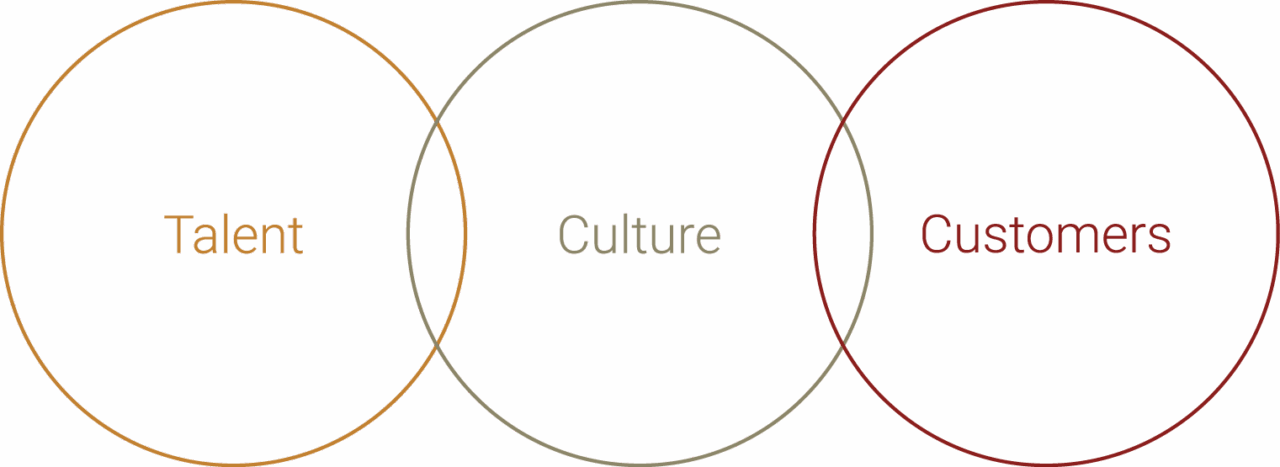
The Customer Demand Zone
The Customer Demand Zone addresses one of the hardest problems in business: customers are becoming harder to read.
They may still buy, renew, take calls, answer surveys, and appear satisfied. But the behavioural signals often show up somewhere else: in slower decisions, softer expansion, workarounds, unused features, delayed urgency, and the gap between what customers say they want and what they actually use.
Customers are the evolving system of needs, behaviours, and expectations that generate demand and shape how your offer is accepted, used, and extended. Demand is not created. It is revealed, interpreted, and responded to.
That is the foundation of the Customer Demand Zone, where customers are active participants in the product, service, and relationship the company creates. Ultimately, they decide whether what the company offers is worth their time, trust, and money.
Customers communicate on two levels. The explicit level tells you where things stand: what they say in calls, surveys, and conversations. The latent level tells you where they are heading: the problem worked around for months without raising it, the use case built around your product because yours did not quite fit, the hesitation that says the need is real but the timing, trust, or urgency is not yet there.
The explicit level tells you about today. The latent level is where the next relevant offer is waiting.
When customers see themselves reflected in what is being created, they engage differently. They stop merely reporting and start participating. They shape what gets built, validate whether it solves the real problem, and share where their business is heading rather than only what they need fixed.
When that receptivity has not been earned, participation rings hollow. The customer may still answer the survey, take the call, or renew the contract. But the deeper signals are turned off.
Customer elasticity works the same way. When trust is high, customers give the company room. They stay and expand even when the experience is imperfect because the relationship is worth it. When elasticity contracts, they pull back. They share less, buy less, expand less, and evaluate alternatives. By the time it shows up in the data, they have already started moving away.
Demand Intelligence Utilization is the company’s ability to close the gap between what customers reveal and what the company builds next. It is the capability to capture what customers are showing, interpret what it means, and apply it where it would change the product, service, promise, or experience.
Most companies gather customer input to improve products or experiences. Fewer use customers as a continuous system input to identify what is emerging, shape what gets prioritized, and influence how the company operates.
Think of the Demand System as a scan of the future: a blueprint of what comes next for the customer and the company. Reading behaviour as emerging demand positions the company and its customer relationships for future growth.
Your customers might be satisfied with your offer today. The question is, what will they want from you next?

The Governing Dynamic
Inside the Performance Ecosystem, customer signals either travel through the company and reshape what gets created, or they do not. The product you bring to market is already showing you which one is happening. Culture is the mechanism that determines it.
The relationship between Culture and Customers runs in both directions. When Culture is working, what a customer shares in a conversation reaches the team deciding what to build next. The signal travels. When it is not, the signal stays with the person who heard it and never reaches the product.
Culture also shapes what customers are willing to share in the first place. When the company has built a culture that earns trust, customers reveal more. They tell you where they are going, not just what they need fixed.
The customer who trusts you tells you what comes next. The one who does not tells you about what you already built.
Both directions show up in the same place: the product.
The product is the barometer of whether the Customer zone is working. It shows whether the company is building from what customers said, or from what their behaviour is revealing. It shows whether the product is moving with the customer, or struggling to keep up with where the customer has already started to go.
A product customers asked for but are not using. A launch that landed with a fraction of the urgency you expected. A renewal that happened but never expanded. Each one can look like an execution problem on its own. Together, they are signs that customer demand is not reaching the work clearly enough.
When the governing dynamic is working, signals travel. What gets built reflects where customers are heading, not only what they asked for last quarter. Relevance strengthens because the company is learning with the customer, not catching up after the fact.
Growth is only better when it remains relevant.
Leadership’s Role in the Customer Zone
Most leaders manage the Customer zone at the level of outcomes. They track satisfaction, review churn, respond when renewal rates soften. When customers show signs of moving, the response is to intervene: improve the experience, add resources to the relationship, sharpen the offer. These responses are important, but they operate downstream from where the customer relationship is actually shaped.
Satisfaction matters, but it is not enough. NPS, churn, and win-loss tell you where the company has been. They do not tell you whether the conditions are in place to earn what customers would actually share, or to ensure that what they share reaches the decisions that shape what gets built next.
Leaders do not directly manufacture performance. They create and sustain the conditions for performance to emerge.
In the Customer zone, this means two responsibilities.
The first is external: creating the conditions that earn the depth of relationship where customers reveal more than what they need fixed. The customer who trusts the company shares where their business is heading. They bring the latent level into the conversation willingly. Without this condition, the company receives explicit signals only.
The second is internal: creating the conditions where what a customer reveals reaches the decision where it can change what gets built. This means building the forums where customer intelligence surfaces across teams instead of staying inside the function that heard it. Without these conditions, what the customer shared stays where it landed, and holds the company back.
That is the shift in role. The leader who governs both conditions stops managing customer outcomes after the fact and starts building the conditions that let the company meet customers where they are going.
Leaders govern the conditions. Conditions govern conversion. Conversion governs growth.

The Real Constraint and the Real Opportunity
Leaders invest in satisfaction, measure churn, track renewal rates, and respond when customer relationships become strained. But customers have been defined too narrowly to capture their full contribution to growth.
Growth does not reflect only the quality of your customers. It reflects how much of what customers are already showing you is reaching the product, service, promise, and experience.
That is the gap.
It shows up where the leadership team least expects it: in a quarter that comes in under what the pipeline suggested, in a relationship that renews but never expands, in a product the team is proud of that the market receives with indifference.
Each one looks like it has its own explanation. Together, they point to the same constraint: customer demand is not reaching the work clearly enough.
Every quarter that goes unaddressed, the cost compounds.
The opportunity is to govern the two conditions that close the gap. The external condition: earning the depth of relationship where customers share where their business is heading. The internal condition: ensuring what they share reaches the decisions that shape what gets built.
When both conditions are working, the product starts reflecting where customers are heading. Expansion conversations happen because the relationship earned them. The company stops building from last quarter’s assumptions and starts building from what customers are showing. Growth stops being a pursuit and starts being a result.
These conditions are addressable. The path through them is knowable.
Your customers are out there. And they’re moving.
Now you know how to meet them where they are going to be.
Series note
This is the third in a quarterly series on the Performance Ecosystem.
April: Talent – the capacity zone, and where convertibility begins.
May: Culture – the conversion environment that determines whether capacity becomes value.
June: Customers – the demand that gives conversion its direction and meaning.
For leaders who are seeing this pattern, this is exactly the work we do together.
Framework note
Most growth companies become more capable than they become effective. The Performance Ecosystem is an original framework developed by David Edward of Strategic Initiatives Group to close that gap: converting the company’s capability into the results it should already be producing. It identifies three interdependent zones: Talent, the capacity zone; Culture, the conversion mechanism; and Customers, the demand zone. Together they are governed by a single cascade: Leaders govern the conditions. Conditions govern conversion. Conversion governs growth. When the system works, the gap between what the company is capable of and what it is producing begins to close. That is Better Growth. Learn more at sigunlimited.com.